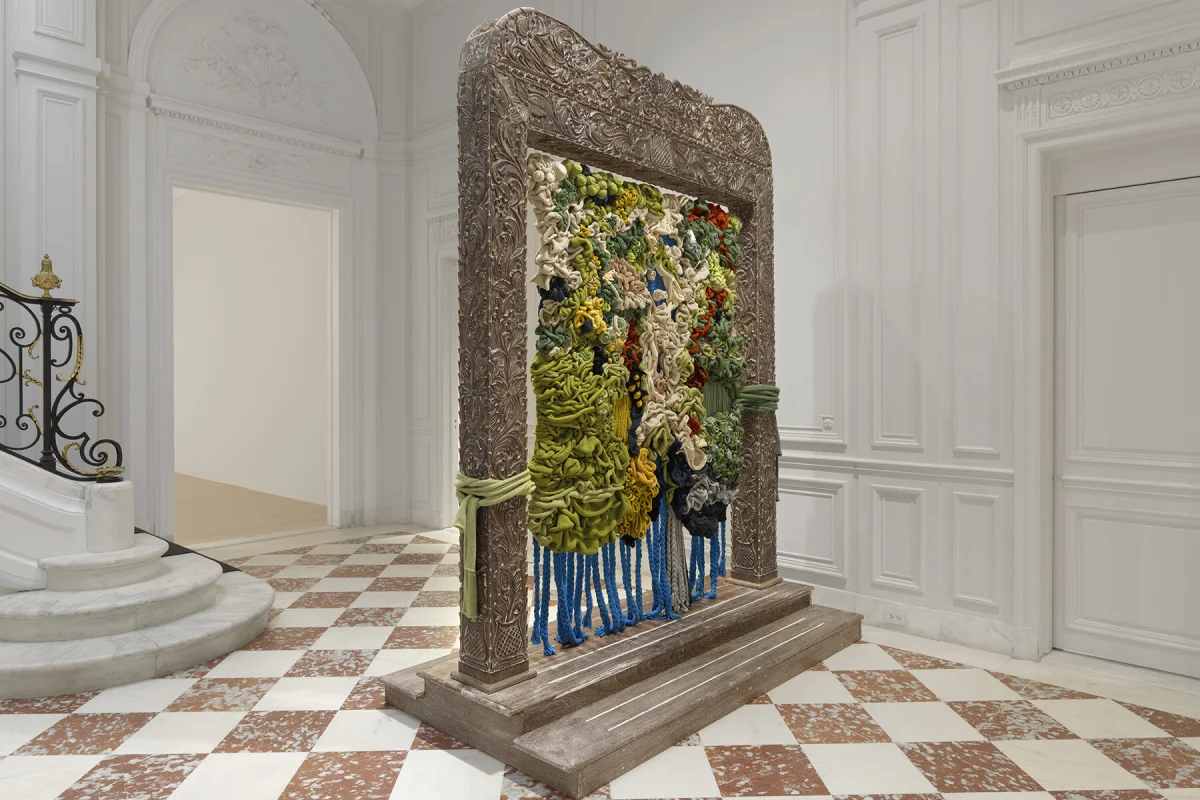
Kenyan artist Wangari Mathenge examines cultural memory and inheritance in her September 2026 exhibition 'Re-membering' at Lévy Gorvy Dayan in New York. Showcasing five new paintings alongside her inaugural public sculptures, the presentation offers a masterclass in how spatial rhythm, material weight, and narrative anchor high-end interiors.
The Architecture of Display and Illumination
Integrating large-scale contemporary artworks into a residential interior requires a disciplined approach to wall space and lighting. At Lévy Gorvy Dayan, the exhibition layout allows each canvas adequate breathing room, preventing visual congestion. In high-end residential design, this principle translates to avoiding the overcrowding of walls.
Lighting plays a critical role in preserving both the integrity of the work and the atmosphere of the room. Museum-grade track lighting with adjustable color temperatures ensures that rich pigments and layered textures are rendered accurately without subjecting delicate textiles or oil mediums to excessive heat or UV degradation. Homeowners looking to showcase significant pieces should invest in recessed, Gimbal-style LED fixtures with narrow beam angles to isolate the artwork from its surrounding architecture.
Materiality and the Weight of Craftsmanship
Mathenge’s expansion into sculpture introduces a tangible, three-dimensional element that complements her heavily textured canvases. In interior architecture, relying solely on flat surfaces can render a space sterile. Introducing sculptural objects—whether carved timber, cast bronze, or ceramics—breaks up the monotony of drywall and glass.
When selecting sculptural elements for a residence, material authenticity dictates longevity. Natural stones, untreated metals, and solid hardwoods develop a patina over time that synthetic substitutes cannot replicate. These elements provide a tactile contrast to smooth plaster walls or polished concrete floors, grounding the room through sensory variety.
Scale, Proportion, and Spatial Rhythm
A common pitfall in luxury interior design is the mismatch between room volume and object scale. Mathenge’s works demonstrate how monumental proportions can anchor a space without overwhelming it. Large canvases command attention, setting the psychological focal point of a room and dictating the placement of secondary furniture.
To achieve this balance at home, designers must consider sightlines from primary entry points. A substantial artwork should be visible from a distance, creating a sense of depth and drawing the eye through the floor plan. Lesser pieces can then be deployed in more intimate zones, such as reading alcoves or transitional hallways, establishing a natural rhythm of scale.
- Use museum-grade, adjustable LED track lighting to accurately render art pigments.
- Balance large-scale canvases with three-dimensional sculptural objects to add tactile depth.
- Allow generous wall negative space around focal artworks to avoid visual clutter.
- Select authentic, raw materials like bronze, stone, and solid timber that patina gracefully.
- Align the scale of your art collection with the volume and sightlines of the room.
For ultra-prime real estate investors, the interior architecture must be conceived with blue-chip art display in mind. Properties that feature considered wall spans, integrated art-lighting circuits, and climate control systems command a distinct premium among international buyers who collect museum-quality works. Integrating spaces capable of hosting significant exhibitions or large-scale paintings elevates a residence from a standard luxury home to a gallery-grade asset. As contemporary artists like Wangari Mathenge gain international institutional recognition, properties equipped to properly house and showcase such cultural assets attract sophisticated buyers looking for turnkey provenance in their living environments.
Related reads
For Wangari Mathenge, Memory Is Something to Rebuild (Design Milk, 29 Sep 2026)
Exhibition | Wangari Mathenge, 'Re-membering' at Lévy Gorvy Dayan, New York, United States (ocula.com, 17 Sep 2026)
Sources & credits
- Feature: Wangari Mathenge Reassembles Memory in ‘Re-membering’ — Design Milk. Linked, not reproduced.
- Main image: Design Milk, from the original feature linked above; all rights remain with the publisher and photographer.
- Headlines via Google News RSS; content belongs to the linked publishers.
Videos are embedded from their original YouTube channels and remain the property of their publishers; ClubProperty hosts no third-party footage or photography. Prices and details are as reported by the sources linked above at the time of writing. Nothing here is financial advice.
Artículos relacionados
Curating Manhattan: Inside Andrew Torrey’s Art-Filled Apartment
Explore how designer Andrew Torrey layered a Manhattan apartment with eclectic art, family heirlooms,…
Leer másThe Evolution of the Living Room Kitchen for 2027
Explore how 2027 kitchen design prioritises lived-in warmth, freestanding furniture, and tactile materials over…
Leer másBalancing English Country Tradition With Unfussy Modernity
Designer Jessica Summer reinterprets the classic English country house through a clean, modern lens,…
Leer másMonolithic Materiality: Inside London’s Brick-Clad Kid
Local studio Box 9 transforms a 307-square-metre Soho corner space into restaurant Kid, using…
Leer más