The debut of the Thompson Rome marks a significant architectural pivot for the Italian capital, converting a substantial 1940s structure into a modern luxury hospitality asset. Reported in October 2026 by publications including the Robb Report, the property showcases how mid-century civic architecture can be successfully reimagined for high-end international travellers.
Architectural Provenance and Mid-Century Roots
The transformation of a 1940s landmark into a contemporary luxury hotel highlights a growing architectural trend across Southern Europe: the adaptive reuse of mid-century commercial and civic buildings. Rather than opting for peripheral greenfield developments, brands are increasingly embedding themselves into the historic fabric of dense European capitals. This specific structure, originating from a distinct era of Italian urban planning, presents a robust architectural envelope defined by rationalist undertones and substantial masonry.
Revamping a building from this period requires a delicate balance between structural preservation and modern engineering upgrades. Architects and designers tasked with the project had to navigate stringent local preservation guidelines while introducing the advanced mechanical, electrical and plumbing systems required by modern five-star hospitality standards. The result is a physical manifestation of Rome’s layered history, where 1940s spatial proportions coexist with contemporary finishes.
Interior Curation and Spatial Experience
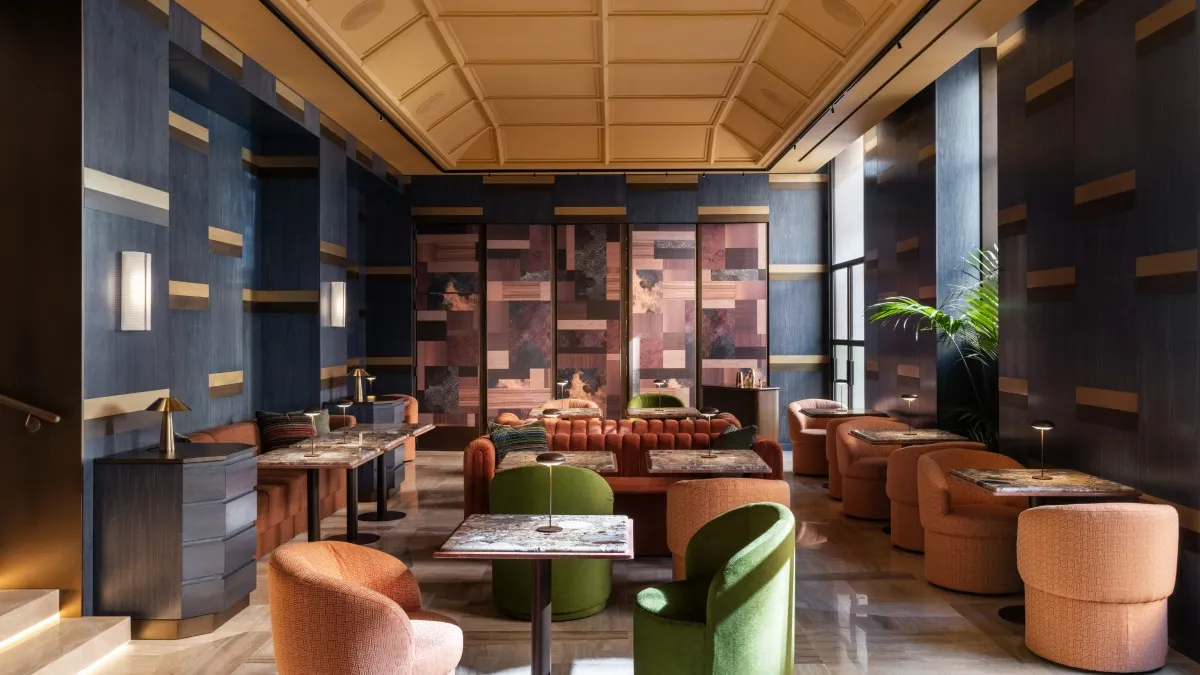
Inside the property, the design narrative moves away from generic international luxury towards a dialogue with local material culture. Public spaces and guest rooms utilise a palette that references classic Roman tones—travertine, muted earth colours and textured plaster—paired with bespoke contemporary furnishings. The layout makes strategic use of the building’s original volume, creating expansive communal areas that encourage social interaction while maintaining intimate seating pockets.
Lighting design plays a critical role in defining the atmosphere, softening the austere geometry typical of 1940s facades and creating a seamless transition between day and night. Custom millwork and curated art selections anchor the interiors in the present day, ensuring the hotel appeals to a discerning clientele that expects both historical context and uncompromising modern comfort.
Hospitality Anchors and Neighbourhood Evolution
The opening of a high-profile international hotel in a central Roman micro-market invariably alters the immediate urban dynamic. Properties of this calibre act as neighbourhood anchors, drawing affluent foot traffic and encouraging the upgrading of surrounding retail and dining infrastructure. For visitors, staying in a converted mid-century landmark offers an alternative to the ubiquitous palazzos and grand-dame hotels clustered around the Spanish Steps or Via del Corso.
Such developments also test the viability of converting non-residential heritage stock into high-yielding commercial assets. As zoning regulations in historic European centres remain notoriously complex, successful projects like the Thompson Rome serve as a operational blueprint for developers looking to unlock value in underutilised urban footprints.
- Adaptive reuse of mid-century buildings successfully bridges historic architectural integrity with modern luxury requirements.
- Prime central locations in Rome continue to attract institutional hospitality investment despite complex regulatory environments.
- High-end hotel openings often signal revitalisation and rising property values in surrounding urban micro-markets.
- Integrating local materials such as travertine grounds international hotel brands in their specific geographic context.
- Converted non-residential heritage assets offer an alternative spatial experience to traditional grand-dame hotels.
The arrival of branded luxury properties like the Thompson Rome in historic districts underscores the resilience and enduring appeal of prime Italian real estate. Institutional interest in adaptive reuse projects remains robust, as developers seek assets that combine historic provenance with modern regulatory compliance. For investors monitoring the Roman market, high-profile hospitality developments act as a reliable bellwether for surrounding residential and commercial values. These projects frequently drive infrastructure improvements and lift demand for luxury pied-à-terre apartments and boutique retail spaces nearby. While entry barriers remain high due to strict preservation laws and limited central land supply, yields in Rome benefit from consistent, year-round international tourism demand.
Related reads
Inside the Thompson Rome, a Luxe New Hotel Nestled in a Revamped 1940s Landmark (Robb Report, 26 Oct 2026)
The Thompson Rome in Photos (Yahoo, 26 Oct 2026)
Jeff Koons Talks AI, a $100 M. Modigliani in Paris, and More: Industry Moves for October 21, 2026 (ARTnews.com, 21 Oct 2026)
Sources & credits
- Feature: Inside the Thompson Rome, a Luxe New Hotel Nestled in a Revamped 1940s Landmark — Robb Report Travel. Linked, not reproduced.
- Main image: Robb Report Travel, from the original feature linked above; all rights remain with the publisher and photographer.
- Headlines via Google News RSS; content belongs to the linked publishers.
Videos are embedded from their original YouTube channels and remain the property of their publishers; ClubProperty hosts no third-party footage or photography. Prices and details are as reported by the sources linked above at the time of writing. Nothing here is financial advice.
Artículos relacionados
The Economics of Colour: Beyond Pantone’s 2027 Predictions
Interior designers eye five shades for Pantone 2027. We examine which colour investments drive…
Leer másReclaiming Industrial Scale: Ricardo Bofill’s La Fábrica
Explore Ricardo Bofill's radical conversion of a 1970s Barcelona cement factory into an architectural…
Leer másJoyce Wang’s Return to Mandarin Oriental The Landmark
Joyce Wang Studio revisits Hong Kong's Mandarin Oriental The Landmark, balancing local heritage with…
Leer másProject MMR: David Ito Arquitetura’s Concrete Pavilion
David Ito Arquitetura designs Project MMR, a São Paulo residence balancing social hosting capacity…
Leer más