





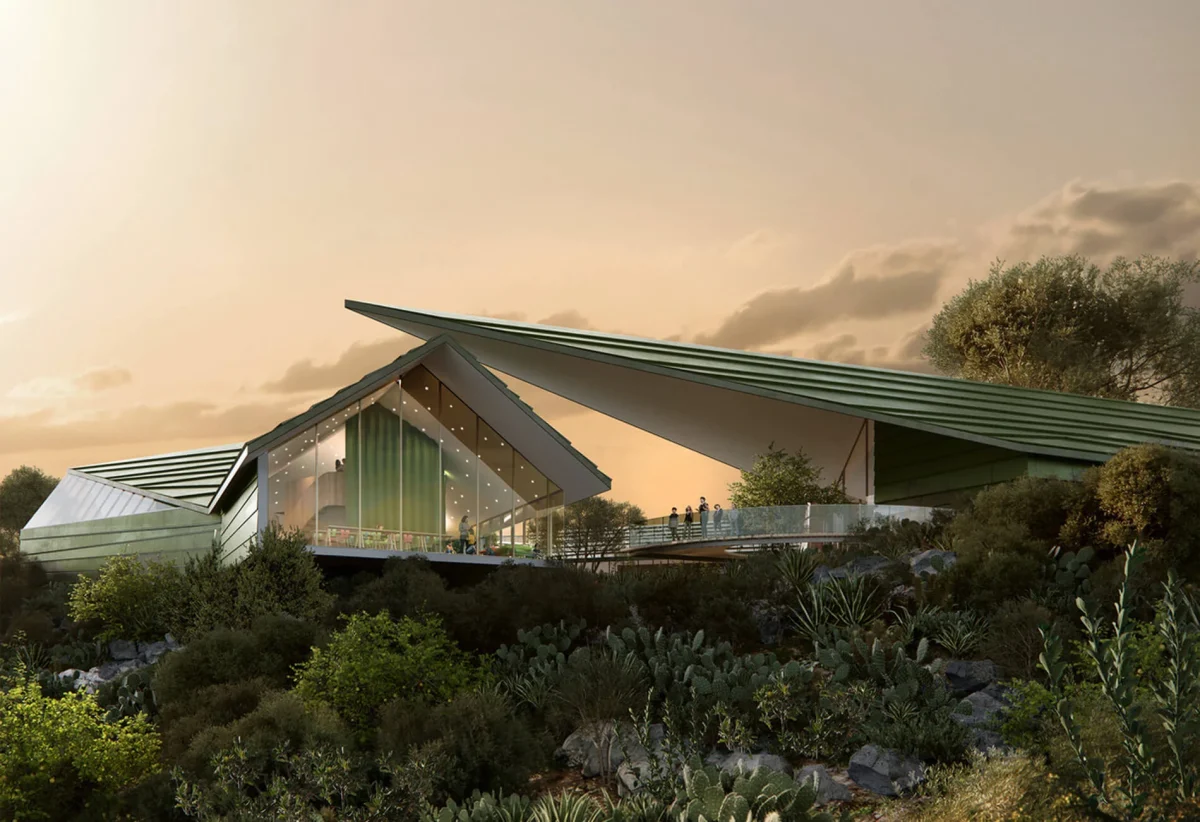
Set to open in December, the 31,000-square-foot New Mexico Literacy Institute in Albuquerque establishes a definitive benchmark for regional civic architecture. Reported as a key initiative of New Mexico Governor Michelle Lujan Grisham, the facility was designed by Multistudio with local practice Design Plus serving as architect of record.
Contextual Integration and Regional Identity
Civic architecture in the American Southwest demands a delicate balance between environmental resilience and cultural expression. The Institute responds directly to the Albuquerque landscape, utilizing forms and spatial transitions that acknowledge the high desert climate. Rather than imposing a generic international style, the design integrates local building traditions with contemporary massing, ensuring the structure anchors itself securely within its geographic context.
The placement of the building prioritises accessibility and civic presence. By creating deliberate sightlines and porous boundaries between the interior programming and the surrounding urban fabric, the architecture invites public engagement. This approach underscores a broader design movement in institutional real estate: creating civic assets that function as community living rooms rather than purely utilitarian structures.
Collaborative Delivery and Architectural Roles
The realization of complex public buildings often relies on division of expertise, a dynamic clearly illustrated by the partnership between Multistudio and Design Plus. Multistudio led the overarching design concept, bringing an international sensibility to the educational program, while Design Plus acted as architect of record, navigating local building codes, municipal approvals, and regional construction methodologies.
This division ensures that conceptual rigor is matched by technical execution. For property investors and developers, observing how nonlocal design practices collaborate with deeply rooted local firms offers a valuable masterclass in risk mitigation and contextual sensitivity. The resulting structure marries visionary spatial planning with rigorous compliance.
Materiality and Spatial Program
Spanning 31,000 square feet, the interior layout is structured to accommodate learners of all ages, transforming literacy education into an inclusive, multi-generational experience. The material palette reflects the southwestern landscape, emphasizing durability, thermal mass, and tactile surfaces that weather gracefully under intense sunlight.
Acoustic management, natural daylighting, and flexible floor plates define the functional core of the building. In premium educational and civic architecture, the ability to reconfigure spaces for varied capacities—from quiet individual study to large community workshops—is paramount. The Institute successfully translates this operational flexibility into a coherent architectural language.
- Leverage local architectural partnerships to navigate regional zoning and climate challenges effectively.
- Prioritise spatial flexibility in civic and institutional buildings to future-proof their utility.
- Integrate material palettes that respond directly to the local climate to reduce lifecycle maintenance.
- Design porous building boundaries to enhance public engagement and community integration.
- Balance iconic design concepts with rigorous technical execution.
While public institutions do not trade on the open market, high-profile civic investments like the New Mexico Literacy Institute exert a stabilizing and elevating influence on surrounding real estate values. Substantial public capital expenditure in infrastructure and education signals municipal confidence, frequently catalyzing adjacent private commercial and residential development. For investors monitoring the Albuquerque market, proximity to major civic anchors serves as a reliable indicator of long-term neighborhood appreciation and sustained urban vitality.
Related reads
Multistudio-designed New Mexico Literacy Institute to open in December (The Architect’s Newspaper, 3 Nov 2026)
Sources & credits
- Feature: New Mexico Literacy Institute by Multistudio and Design Plus to open in December — The Architect's Newspaper. Linked, not reproduced.
- Main image: The Architect's Newspaper, from the original feature linked above; all rights remain with the publisher and photographer.
- Headlines via Google News RSS; content belongs to the linked publishers.
Videos are embedded from their original YouTube channels and remain the property of their publishers; ClubProperty hosts no third-party footage or photography. Prices and details are as reported by the sources linked above at the time of writing. Nothing here is financial advice.
Relaterte artikler
The Reality Check for AI Design Visualisers
Generative AI tools are flooding the architectural market with fantastical renders. Buyers must separate…
Les merThe End of Minimalism: Inside the Anti-Trend Kitchen
Explore how warm wood, stone, and copper create a timeless, high-value kitchen interior that…
Les merDesigning the Enduring Kitchen: Lessons from 1970s Archives
Examine how archival 1970s kitchen design principles, such as classic subway tiles, offer enduring…
Les merThe Staircase as Facade: Structural Circulation in Design
Explore how contemporary architects use exterior staircases to redefine building facades, merging structural circulation…
Les mer