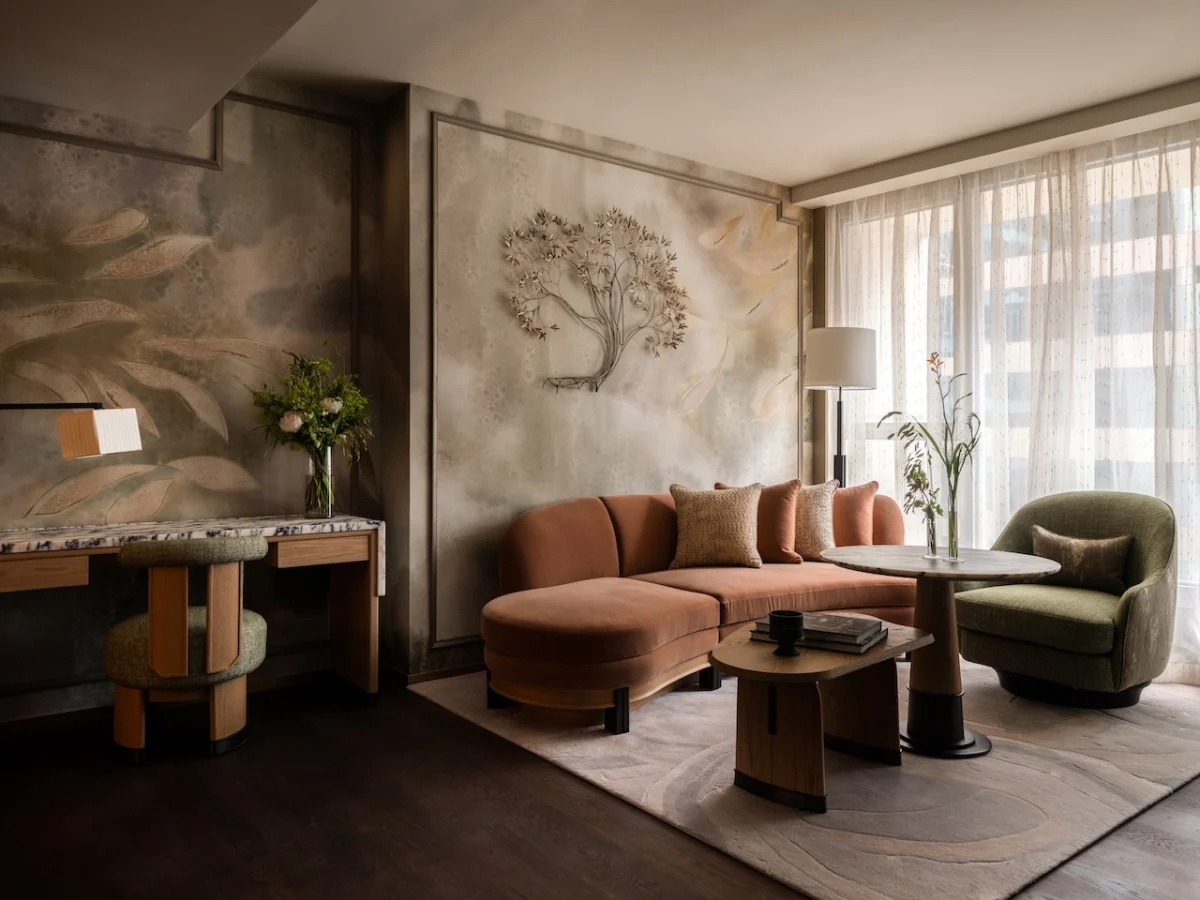
More than ten years after its initial redesign, Joyce Wang Studio has completed a comprehensive return project at Hong Kong's Mandarin Oriental The Landmark. The updated interiors draw directly upon the city's architectural vernacular, landscape, and historical layers.
Materiality and Local Context
The studio’s approach centers on grounding the luxury hospitality environment in a distinct sense of place. Rather than relying on generic international hotel tropes, the design incorporates tactile surfaces and custom millwork that reflect Hong Kong’s dense urban texture and surrounding topography.
Textured stone, brushed metals, and rich timber veneers create a layered visual experience. These choices prioritize durability and tactile aging, ensuring the spaces withstand heavy use while developing a sophisticated patina over time.
Light, Layout, and Spatial Flow
Spatial reconfiguration within the property focuses on improving guest circulation and maximizing natural light penetration. Thoughtful partitioning defines intimate zones without sacrificing the openness required in contemporary luxury environments.
Layered lighting schemes combine ambient concealed fixtures with bespoke decorative pendants. This allows spaces to transition seamlessly from functional daytime utility to moody, atmospheric evening settings.
Translating Hospitality Design to Residential Spaces
High-end hospitality projects offer valuable lessons for private residential design, particularly regarding acoustic comfort, bespoke storage integration, and durability under high-traffic conditions.
Investors and homeowners can replicate these effects by investing in foundational fixed elements—such as architectural joinery and high-grade natural flooring—while keeping movable furniture and soft furnishings neutral and easily updated.
- Prioritise natural, tactile materials that age gracefully over synthetic alternatives.
- Anchor spaces with bespoke architectural millwork rather than trend-driven standalone furniture.
- Use layered lighting to create adaptable moods for different times of day.
- Draw inspiration from local geography and history to give interiors a permanent sense of place.
- Maintain flexible spatial layouts that balance openness with intimate functional zones.
In the upper tiers of hospitality and residential real estate, recurring design refreshes are essential to maintain competitive positioning and command premium nightly rates or square-metre valuations. The recent accolades received by the property, including its recognition with two Michelin Keys as reported by La Revue des Hôtels, underline how strategic, heritage-informed interior updates directly support asset performance. For real estate investors, committing capital to timeless materials and expert craftsmanship rather than fleeting aesthetic fads protects long-term equity and reduces the frequency of capital-intensive overhauls.
Related reads
Joyce Wang Studio Returns to Mandarin Oriental The Landmark a Decade Later (Design Milk, 26 Oct 2026)
Joyce Wang Studio looks to Hong Kong’s heritage for Mandarin Oriental The Landmark (SPACE | International Hotel Design, 5 Oct 2026)
The Mandarin Oriental The Landmark hotel in Hong Kong wins two Michelin Keys after its makeover (La Revue des Hôtels, 5 Oct 2026)
Our Asia insider reveals five Hong Kong hotels actually worth the trip in 2026 (Forbes Australia, 22 Oct 2026)
Sources & credits
- Feature: Joyce Wang Studio Returns to Mandarin Oriental The Landmark a Decade Later — Design Milk. Linked, not reproduced.
- Main image: Design Milk, from the original feature linked above; all rights remain with the publisher and photographer.
- Headlines via Google News RSS; content belongs to the linked publishers.
Videos are embedded from their original YouTube channels and remain the property of their publishers; ClubProperty hosts no third-party footage or photography. Prices and details are as reported by the sources linked above at the time of writing. Nothing here is financial advice.
Powiązane artykuły
The Gentleman: Art Deco Proportion Meets Height in Potts Point
YSG Studio reconfigured a 1929 Potts Point apartment for two very tall clients, balancing…
Czytaj więcejThe Sixth Wall: Why Statement Floors Are Reshaping Interiors
Explore how statement flooring, from rich red-and-black tiles to bespoke wool rugs, is replacing…
Czytaj więcejThe Economics of Colour: Beyond Pantone’s 2027 Predictions
Interior designers eye five shades for Pantone 2027. We examine which colour investments drive…
Czytaj więcejJohn Yeon’s Swan House in Portland Seeks Buyer
The legendary 1950 Swan House by architect John Yeon in Portland, Oregon, returns to…
Czytaj więcej