


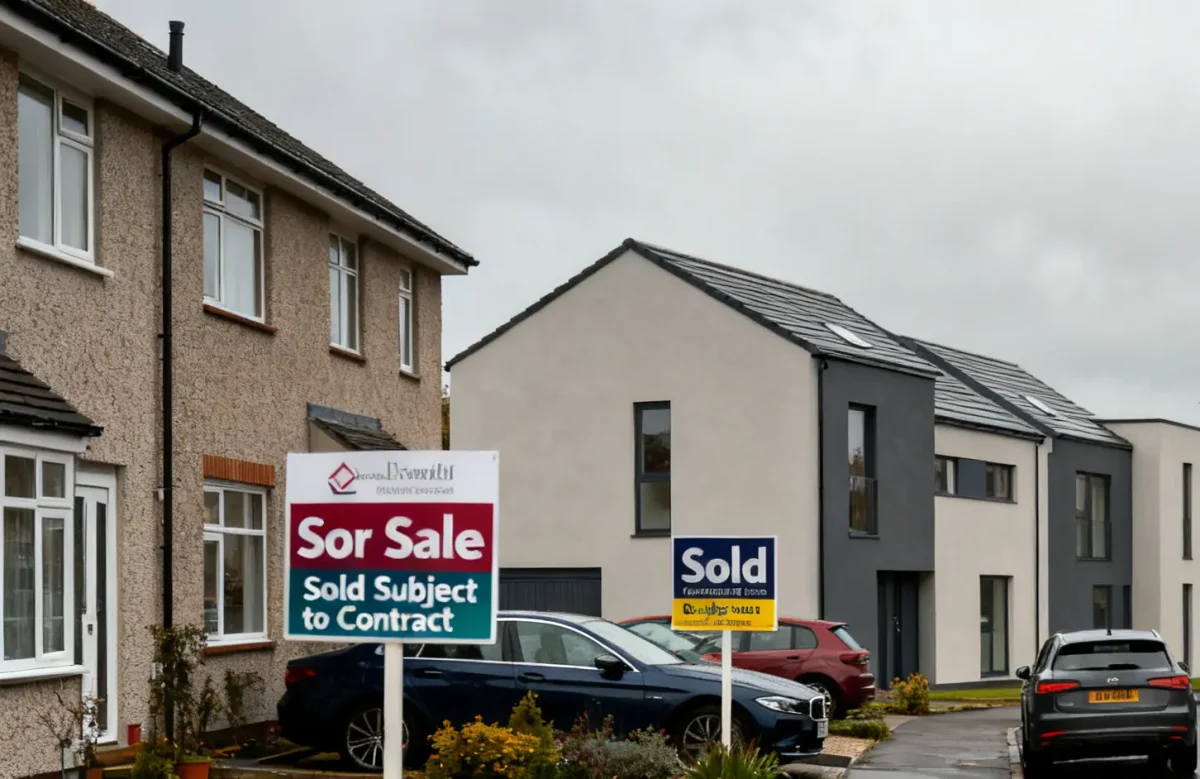
Annual UK house price growth decelerated to just 0.5% in October 2026, marking the slowest pace of expansion in over two years. The average residential property price remained flat at £273,566 as persistent financing pressures dampened market activity across the country.
Financing Obstacles and Borrowing Thresholds
The primary driver behind the sudden cooling of the United Kingdom residential property market is the sharp upward movement in borrowing costs. Data published by Property Wire in October 2026 indicates that average mortgage rates have breached the critical 6% threshold, fundamentally altering affordability calculations for prospective buyers.
Higher interest rates directly reduce maximum borrowing capacities, forcing many purchasers to re-evaluate their budgets or postpone transactions entirely. Lenders have responded to broader monetary policy adjustments by repricing fixed-rate products, introducing an element of caution into the lending environment that restricts aggressive bidding and rapid price escalation.
Surveyor Sentiment and Diminishing Buyer Enquiries
Market sentiment among property professionals has shifted noticeably. Chartered surveyors contributing to recent market indices report a distinct softening in new buyer enquiries across mainstream residential sectors. This contraction in demand indicates a widening expectation gap between vendors, who often retain historical pricing ambitions, and purchasers adjusting to the realities of expensive debt.
Consequently, market liquidity has dipped. Transactions are taking longer to complete, and properties requiring modernization or located in secondary micro-locations face downward price adjustments to secure qualified buyers. The overall flat monthly movement in average values underscores a broader stalemate in transactional volume.
Implications for Leveraged Versus Unleveraged Capital
The current market environment draws a sharp dividing line between debt-dependent buyers and those deploying liquid capital. Cash purchasers and equity-rich investors encounter less friction in navigating the October 2026 market, occasionally leveraging reduced competition to negotiate favorable terms on prime properties.
Conversely, buyers reliant on mainstream mortgage finance must navigate stringent stress-testing by lenders. This dynamic has concentrated activity in more resilient asset classes and prime urban pockets, while suburban and entry-level segments absorb the brunt of the adjustment.
- Average UK property prices remained flat at £273,566 in October 2026, with annual growth slowing to 0.5% according to Property Wire data.
- Mortgage rates breaching the 6% threshold have constrained buyer borrowing capacity and lengthened transaction timelines.
- Surveyor reports highlight weaker buyer enquiries and a growing expectation of short-term price adjustments in mainstream segments.
- Cash-backed investors face reduced competition and enhanced negotiating leverage compared to leveraged retail buyers.
- Consult qualified financial and legal advisers before structuring property acquisitions in high-interest rate environments.
The deceleration of UK house price growth to 0.5% in October 2026 signals a necessary market re-pricing following years of pandemic-era acceleration. For investors, this environment demands rigorous due diligence and selective asset selection. While mainstream leveraged purchases face yield compression due to elevated mortgage costs, well-capitalised buyers can exploit the temporary stalemate to acquire assets below peak valuation. Prime properties with strong fundamental drivers—such as transport connectivity, architectural merit, and structural supply constraints—remain the most reliable hedge against macroeconomic volatility. Investors should monitor lender product availability and regional transaction volumes closely before committing capital.
Related reads
U.S. mortgage rates climb above 7% in another blow to housing market (Marketplace.org, 23 Sep 2026)
Annual U.S. House Price Growth Slows to Weakest September Pace in 15 Years (themortgagepoint.com, 26 Oct 2026)
October ICE Mortgage Monitor: Annual home price growth was 1.4% in September (Substack, 6 Oct 2026)
US home sales slowest in more than a year as mortgage rates and prices climb (The Guardian, 10 Sep 2026)
Ski town housing markets face slower sales amid rising mortgage rates, as luxury market outperforms trends (AspenTimes.com, 15 Oct 2026)
Sources & credits
- Feature: UK house price growth slows to 0.5% as mortgage rates climb — Property Wire. Linked, not reproduced.
- Main image: Property Wire, from the original feature linked above; all rights remain with the publisher and photographer.
- Headlines via Google News RSS; content belongs to the linked publishers.
Videos are embedded from their original YouTube channels and remain the property of their publishers; ClubProperty hosts no third-party footage or photography. Prices and details are as reported by the sources linked above at the time of writing. Nothing here is financial advice.
Связанные статьи
Evaluating the US Housing Market Through Regional Rankings
An analysis of the Architectural Digest 2026-2027 index for the US, examining how lifestyle…
Читать далееUK Housing Tax Reform: Abolishing Stamp Duty and Council Tax
Oxford academic John Muellbauer calls for sweeping UK property tax reform, proposing the abolition…
Читать далееSpain’s Residential Property Market Faces Price Moderation
Spain’s housing sector enters a recalibration phase as third-quarter data points to slowing price…
Читать далееAustralia Healthcare Real Estate Investment Trends
Strategic capital shifts are reshaping Australia's healthcare real estate sector as demographic pressures and…
Читать далее