


For decades, luxury real estate was a numbers game. Square footage, marble tonnage, the height of the ceilings, the size of the chandelier. The bigger and shinier, the better. That era is over.
In 2026, the world’s wealthiest buyers are spending more on their homes than ever before — home-related spending among those with $30 million-plus net worth is projected to outpace personal luxury goods spending by 18.5% — but they’re spending it differently. The new ultra-luxury client is more intentional, more health-conscious, and more skeptical of empty grandeur. They want homes that feel like sanctuaries, not showrooms. And the developers paying attention are the ones building the most coveted addresses in the world.
Here’s what’s actually moving the needle at the top of the market.
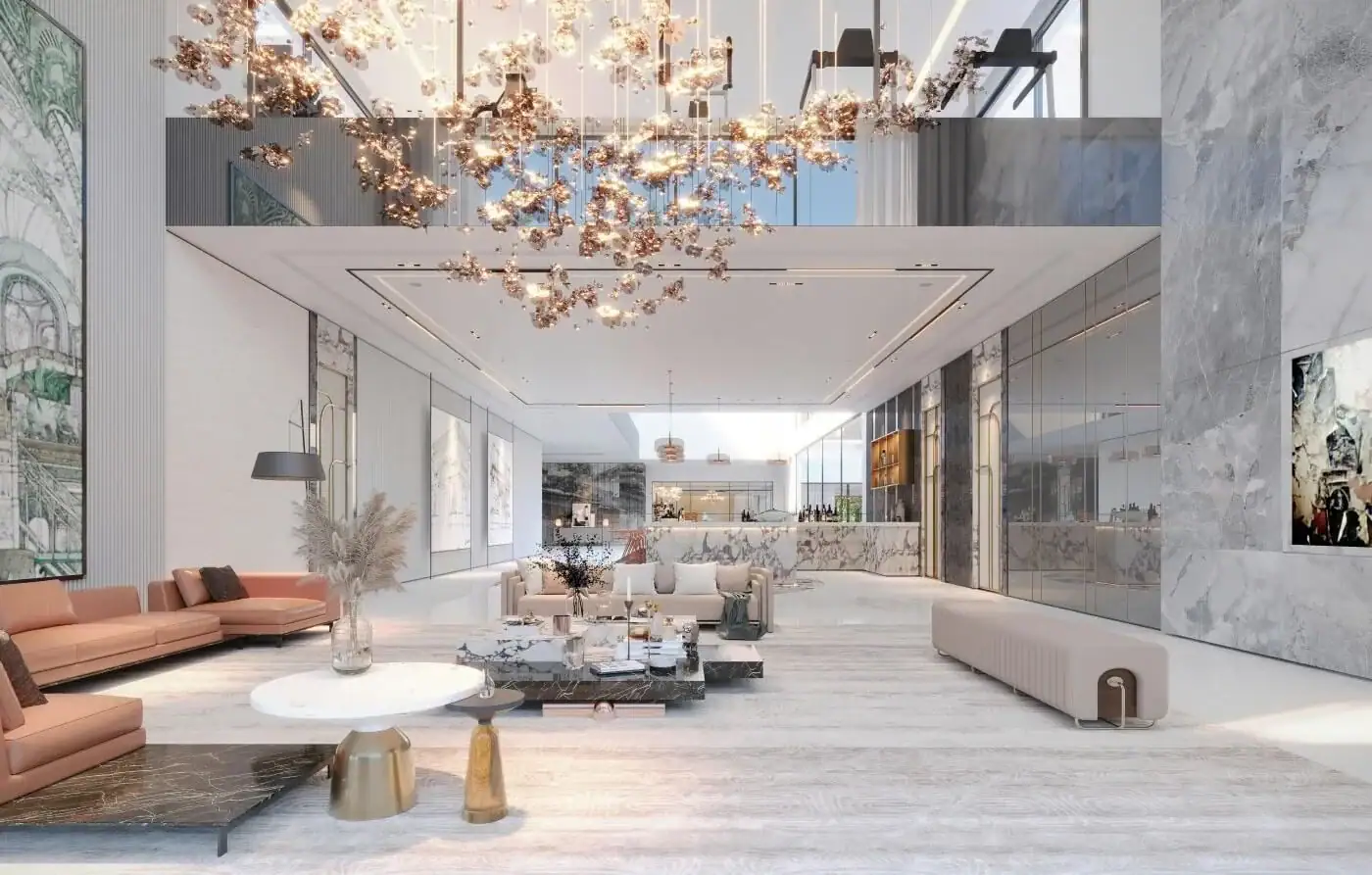
1. The Quiet Material Renaissance
The biggest shift in ultra-luxury design isn’t about a color or a style — it’s about what things are made of. The most desirable homes today are distinguished not by bold palettes, but by their materiality.
We’re seeing a decisive move away from cold, high-gloss finishes toward materials with texture, depth, and a tactile story. Lime-washed and hand-troweled plaster walls. Wide-plank rift-cut white oak. Honed travertine. Unfilled limestone. Bookmatched onyx used sparingly as a single sculptural moment rather than a wall-to-wall flex. Patinated brass and unlacquered nickel that age in real time.
The buyer at this level can identify a veneered MDF panel from across the room. They want solid stock, hand-applied finishes, and joinery that betrays the hand of a craftsperson. Reclaimed beams, antique European limestone fireplaces, and salvaged terracotta floors are being integrated into otherwise contemporary architecture to give new builds a sense of provenance. Authenticity beats novelty, every time.
Color palettes have softened in parallel — plaster whites, limestone, pale mushroom, refined greige, deep clay, olive, and charcoal — layered to create depth without contrast. Architecture and materials lead; color supports.
2. Wellness Has Moved From Amenity to Infrastructure
A gym and a steam shower used to qualify a home as wellness-oriented. Not anymore. The 2026 ultra-luxury home is a regenerative ecosystem — a piece of wellness infrastructure that actively works on the body all day, whether the resident notices or not.
What that looks like in practice:
- Air and water systems built into the home’s bones. Hospital-grade HEPA filtration, separate humidity zones, reverse-osmosis and structured-water systems on every tap, and air-quality sensors tied into the climate control.
- Sleep architecture — primary suites engineered with circadian lighting, blackout-grade glazing, dedicated HVAC zoning for sleep temperatures, and acoustic isolation that approaches recording-studio standards.
- Recovery suites that have largely replaced the home gym as the central wellness space: infrared and traditional saunas, cold plunges, hyperbaric chambers, red-light therapy rooms, contrast hydrotherapy, and increasingly, dedicated rooms for IV drips and concierge medical visits.
- Movement spaces designed for specific practices — Pilates studios with proper reformer clearance, dedicated yoga rooms with natural materials and indirect light, golf simulators that double as performance training spaces.
The framing has shifted. These features aren’t lifestyle perks anymore — they’re presented (and priced) as longevity infrastructure.
3. Sustainability as Standard, Not Statement
The notion that sustainability compromises luxury has been definitively overturned. At the top of the market, environmental performance is now a baseline expectation, not a marketing angle.
What ultra-luxury buyers expect:
- Passive house principles and net-zero energy performance — homes that produce as much energy as they consume, with continuous insulation, triple glazing, and heat-recovery ventilation as standard.
- Integrated renewables: solar tied to large-format battery storage (Tesla Powerwall, Enphase, or bespoke systems), geothermal heating and cooling, and increasingly, on-site water capture and greywater recycling.
- Material transparency: documented supply chains, low-VOC everything, FSC-certified timber, and a growing preference for low-carbon concrete, recycled metals, and bio-based composites.
- Top-tier certifications — LEED Platinum, Passive House, Living Building Challenge — increasingly cited in marketing for nine-figure homes.
The smartest developers are framing this as long-term asset protection. Operating costs are lower, regulatory risk is lower, and increasingly, resale values are higher for documented-performance homes.
4. The Branded Residence Boom
This is arguably the single biggest structural shift in luxury development. The branded residences sector has grown by more than 180% over the past decade, rising from 323 projects globally in 2015 to 910 in 2025, with supply expected to double again by 2030.
The pitch is straightforward: own a private home with the operating platform of a Four Seasons, Aman, Six Senses, Bulgari, or Ritz-Carlton behind it. Twenty-four-hour concierge, housekeeping, in-residence dining, spa access, security, and crucially — consistency. A buyer can travel for six months and return to a home that has been professionally maintained, with familiar staff and uniform service standards.
For developers, the branded model commands meaningful price premiums (typically 25-35%, sometimes higher in emerging markets) and tends to sell faster pre-construction. For buyers — especially those with multiple homes — it removes the operational headache of luxury homeownership.
What’s evolving in 2026: differentiation beyond the brand name itself. As supply grows, simply slapping a hotel logo on a tower no longer guarantees success. The winning projects pair the brand with genuinely distinctive architecture, location, and bespoke amenities (private beaches, pet care suites, member-only restaurants), and increasingly, with standalone configurations that prioritize residential privacy over hotel co-location.
5. Indoor-Outdoor Living, Properly Executed
Biophilic design has become non-negotiable at the high end, but the bar has risen considerably. Sliding glass doors and a terrace no longer cut it.
What’s actually being built:
- Retractable wall systems — frameless, multi-panel pocket doors that fully disappear, often spanning 30-50 feet, blurring the threshold between interior and landscape.
- Outdoor rooms designed as primary living spaces, not afterthoughts: full summer kitchens with hearth ovens, outdoor lounges with proper heating and weather protection, covered dining for 20-plus, integrated audio and lighting.
- Water as architecture — reflecting pools, infinity edges that read into the horizon, indoor-outdoor pools, water walls, and natural-bottom plunge pools.
- Mature landscaping at handover — buyers at this level don’t want to wait ten years for the trees to grow. Developers are sourcing and transplanting specimen olive trees, mature palms, and century-old hedging as part of the package.
- Vertical gardens, living walls, and atrium gardens that bring the landscape indoors, particularly in urban towers where outdoor square footage is constrained.
6. Privacy and Security as the New Status Symbol
If the 2010s luxury home was about being seen, the 2026 ultra-luxury home is about not being seen. Privacy has become the most valuable commodity in residential design.
Practically, this means:
- Discreet arrivals — motor courts that shield arrivals from the street, private elevator access from parking directly into the residence, separate service entrances and circulation for staff and deliveries.
- Layered security that’s invisible to the resident: ballistic glazing, biometric access, panic rooms (often disguised as wine cellars or closets), and increasingly, full cybersecurity audits of every connected device in the home.
- Operational privacy — house managers, security personnel, and staff with non-disclosure agreements and trained discretion. In branded residences, the building itself functions as a privacy moat.
- Physical separation within the home — primary suite wings that can be locked off from the rest of the house, separate guest wings with their own entrances, staff quarters with independent circulation.
For high-profile buyers — and increasingly, for buyers who simply value calm — this is more important than any single design feature.
7. Invisible Technology
Smart-home technology used to be a feature you bragged about. Now it’s something that should be felt but not seen. The best technology in 2026 luxury homes is the technology you never have to think about.
What this looks like:
- Climate, lighting, shade, and audio systems that learn behavior patterns and adjust without input. Walk into a room at 7 a.m., and the curtains lift to a programmed angle, the lights hit a specific Kelvin temperature, the floors warm, and your preferred playlist resumes where you left off.
- Hidden integration: speakers concealed in plaster ceilings, screens that disappear behind mirrors or art, switches replaced with single-tap surfaces or voice control, all wiring designed to be invisible.
- Centralized control via discreet tablets or voice — and critically, with manual overrides everywhere, because the worst luxury experience is one where the technology fails and the resident can’t open a window.
- AI-driven property management behind the scenes — predictive maintenance, energy optimization, and security monitoring that operate without involving the homeowner.
The principle: technology should enhance the experience, not announce itself.
8. Spaces for How People Actually Live Now
Open-plan everything is on the way out. The 2026 ultra-luxury home reflects a more nuanced understanding of how its residents actually use space — and increasingly, that means defined rooms with specific purposes.
The spaces that are appearing (or reappearing) in nine-figure homes:
- Executive suites that replace the makeshift pandemic home office — dedicated work wings with conference capabilities, private entrances for visiting executives, and acoustic isolation.
- Multi-generational layouts — self-contained guest cottages, dual primary suites for aging parents or adult children, and flexible floor plans that can be reconfigured over time.
- Dedicated entertaining spaces separated from family living areas — formal dining, catering kitchens with separate prep zones, wine cellars and tasting rooms, and home theaters that work for 12-person screenings rather than family movie night.
- Hobby spaces with serious infrastructure — full art studios with north light, professional-grade music rooms, climate-controlled garages designed as gallery spaces for car collections, and indoor courts (squash, padel, basketball).
The unifying idea: the home as a complete lifestyle platform, where residents don’t need to leave to access the things they care about.
What This Means for Developers
The buyer at the top of the market in 2026 is not buying a finish package. They’re buying a future experience — and they’re paying a premium for cohesion, authenticity, and operational excellence.
The developments winning this market share a few things in common. They commit to materials and craftsmanship that won’t be visible on a spec sheet but will be felt on day one of occupancy. They build wellness, sustainability, and privacy into the architecture rather than bolting them on. They partner with operators who can deliver consistent service for decades, not just sell out the launch. And they design for a generation of buyers — Gen X and Millennials who will inherit roughly $2.4 trillion in U.S. real estate wealth over the next decade — who view real estate as a strategic, long-term piece of their wealth and well-being, not a trophy.
Opulence is easy. Intention is what sells now.
Related Articles
Panama Property Q4 2026: Inventory at a Nine-Year Low and Prices on the Move
Market outlook · Q4 2026 Panama Property Q4 2026: Inventory at a Nine-Year Low…
Read moreMonaco Property Q4 2026: 2 km², €57,000 a Square Metre and Nowhere to Build
Market outlook · Q4 2026 Monaco Property Q4 2026: 2 km², €57,000 a Square…
Read moreSwiss Property Q4 2026: Zero Rates, Empty Flats and Prices That Won’t Blink
Market outlook · Q4 2026 Swiss Property Q4 2026: Zero Rates, Empty Flats and…
Read moreMultilingual Real Estate Flyer Maker: Create Property Flyers from Your Listing
New on ClubProperty Turn any listing into a beautiful flyer, in any language Create…
Read more