Designed for poet and filmmaker Shiroyasu Suzuki, Kazuo Shinohara's House on a Curved Road has appeared on the Tokyo market with an asking price of one billion yen. Reported by both The Architect's Newspaper and Domus Web, the property represents a rare opportunity to acquire a residential work by one of Japan's most uncompromising modernist figures.
An Architectural Cult Classic
Kazuo Shinohara occupies a legendary status within international architectural circles, often described as an architect’s architect. His theoretical framework and spatial geometry heavily influenced contemporary practitioners such as Valerio Olgiati and Christian Kerez. Operating largely outside commercial mainstream trends during his career, Shinohara treated each residential commission as a rigorous spatial experiment.
The House on a Curved Road exemplifies his fourth style period, characterized by dynamic structural systems and a visceral engagement with urban geometry. Commissioned by poet and filmmaker Shiroyasu Suzuki, the residence responds directly to its idiosyncratic Tokyo site, translating spatial constraints into compositional rigor.
Site, Structure and Spatial Dynamics
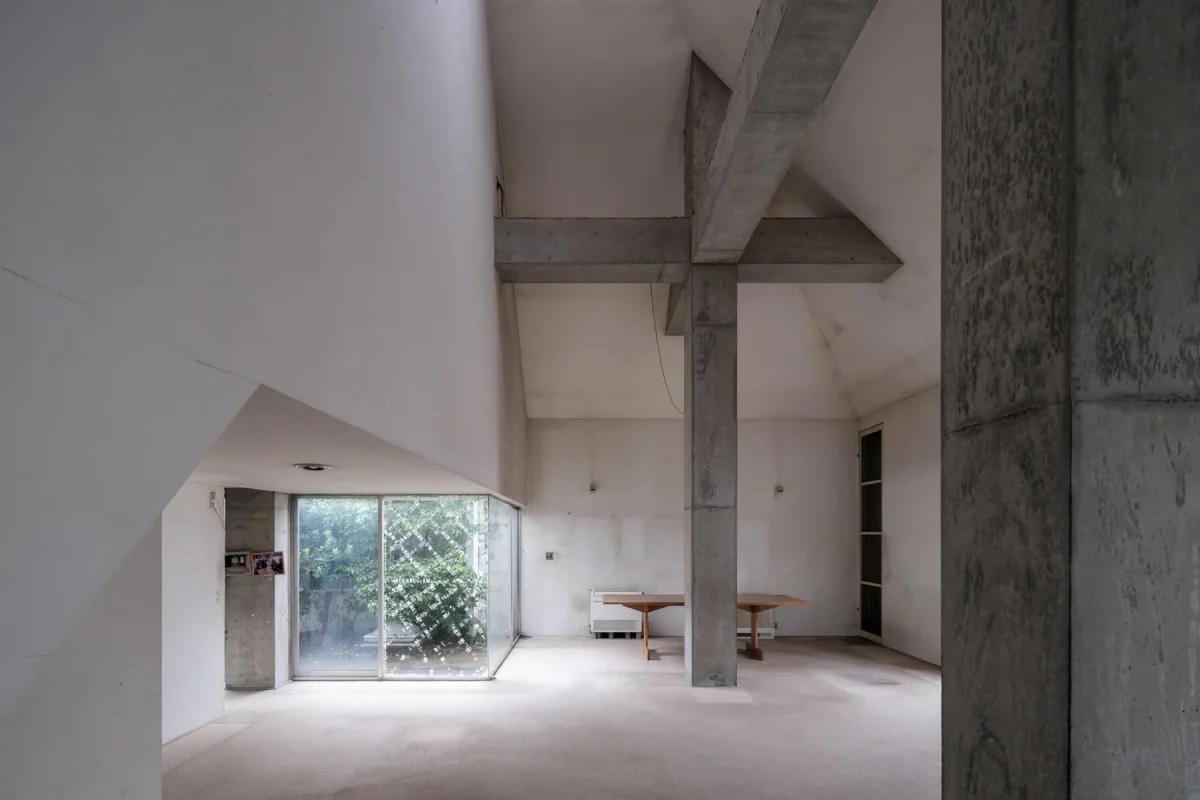
The building’s geometry is dictated by the sweep of the road it faces, resulting in an unconventional plan that challenges standard domestic typologies. Shinohara manipulated interior volumes through exposed structural elements, stark transitions in scale, and precise apertures that frame urban vistas while maintaining privacy.
Materials are deployed with characteristic restraint. Concrete, timber and industrial finishes dominate the construction, reflecting Shinohara’s interest in the raw expression of structural components. The interplay of natural light across these austere surfaces creates an interior atmosphere that shifts dynamically throughout the day, serving the contemplative needs of its original creative occupant.
The Modernist Heritage Market
Acquiring a certified architectural masterwork in Tokyo involves navigating both heritage preservation considerations and the city’s notoriously fast-paced real estate cycles. Unlike standard luxury new-builds, homes by recognized modernist masters function as collectible cultural assets. Maintenance requires adherence to the original architectural intent, demanding specialist conservation knowledge from any prospective custodian.
Properties of this caliber rarely transition to the open market. Their valuation relies less on standard square-metre metrics and more on art-market dynamics, where provenance, rarity and the creator’s historical significance drive pricing structures.
- Architectural provenance significantly enhances the long-term cultural and financial value of a residential asset.
- Unconventional site geometries, when handled by master architects, can generate unique spatial experiences rather than functional compromises.
- Custodianship of modernist masterworks requires a commitment to preserving original structural and material integrity.
- Raw industrial materials like exposed concrete and timber require specialized maintenance protocols in urban environments.
- Collectible real estate operates independently of standard residential market cycles, appealing directly to architectural connoisseurs.
Priced at one billion yen, this offering sits outside standard comparative market analyses for Tokyo residential real estate. Properties designed by internationally acclaimed architects like Kazuo Shinohara function similarly to fine art or rare design objects. Liquidity is naturally lower than conventional luxury condominiums, but the buyer pool consists of high-net-worth collectors and global institutions capable of recognizing long-term cultural dividends. For the discerning investor, owning a foundational work of twentieth-century Japanese modernism provides a distinct hedge against the depreciation typical of standard urban housing stock, securing a permanent place in architectural history.
Related reads
One of Japan’s most radical modernist houses is for sale in Tokyo (Domus Web, 22 Oct 2026)
Sources & credits
- Feature: In Tokyo, Kazuo Shinohara’s House on a Curved Road, designed for poet and filmmaker Shiroyasu Suzuki, is for sale for one billion yen — The Architect's Newspaper. Linked, not reproduced.
- Main image: The Architect's Newspaper, from the original feature linked above; all rights remain with the publisher and photographer.
- Headlines via Google News RSS; content belongs to the linked publishers.
Videos are embedded from their original YouTube channels and remain the property of their publishers; ClubProperty hosts no third-party footage or photography. Prices and details are as reported by the sources linked above at the time of writing. Nothing here is financial advice.
Related Articles
Evaluating the US Housing Market Through Regional Rankings
An analysis of the Architectural Digest 2026-2027 index for the US, examining how lifestyle…
Read moreTimeless Design Choices from Mexico City’s Book‑Lined Bar
How material, light and layout in Em‑Estudio’s basement bar create lasting value and ideas…
Read moreThe Architecture of Color: How to Use Bold Hues with Discipline
Master the application of saturated tones in premium interiors with strategic material pairing, lighting…
Read moreIlluminating the Threshold: Exterior Lighting Design and Value
Explore how intentional exterior lighting design enhances residential appeal, balances atmosphere, and protects long-term…
Read more