





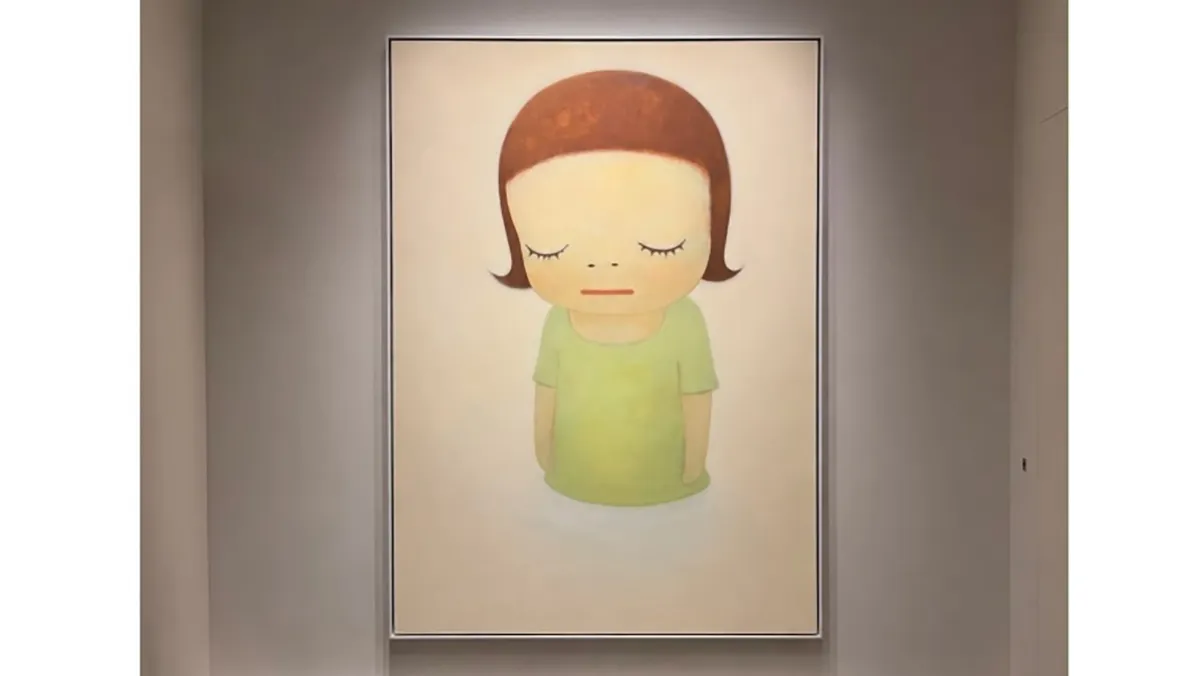
Recent high-profile art auctions, culminating in Yoshitomo Nara’s canvas fetching $15.9 million, underscore the parallel liquidity of fine art and prime real estate. These two asset classes increasingly dictate the spatial and architectural demands of ultra-prime residences globally.
The Intersection of Fine Art and Global Capital
The autumn auction season has delivered extraordinary benchmarks across the international cultural capitals. Most notably, Yoshitomo Nara’s painting In the Milky Lake / Thinking One achieved $15.9 million through Fairward, outperforming several contemporary lots in New York. This transaction follows historic results reported by Sotheby’s, including a Van Gogh canvas realizing $190.4 million and a Monet setting a French auction record at $56.2 million in Paris.
For international property buyers, these figures are rarely isolated cultural events. Instead, they serve as reliable indicators of discretionary liquidity among ultra-high-net-worth individuals. Capital that flows heavily into museum-grade art is frequently deployed in parallel within prime residential markets such as Mayfair, Manhattan’s Billionaires’ Row, and the Sixth Arrondissement of Paris.
Architectural Demands of Museum-Grade Interiors
Owning blue-chip contemporary art fundamentally alters the interior architecture of a residence. Modern buyers increasingly demand properties equipped with gallery-grade specifications rather than conventional domestic finishes. This shifts interior design priorities toward museum-standard environmental controls, linear LED washing systems, and reinforced load-bearing walls capable of supporting monumental canvases or heavy sculptures.
Architects working in the prime sector must collaborate closely with lighting consultants and conservators. Natural ultraviolet light must be meticulously filtered through specialized glazing, and HVAC systems require multi-zone humidity monitoring to protect multi-million-pound collections. Consequently, the presence of a dedicated, climate-controlled art display room has transitioned from a niche luxury to a standard baseline requirement in newly developed super-prime developments.
Geographic Clustering of Culture and Real Estate
The correlation between high-value art transactions and prime property values is most visible in established cultural hubs. Cities that host major international art fairs—such as Art Basel in Switzerland or Frieze in London—consistently record resilient residential property values even during broader economic contractions.
Buyers active in these markets view their real estate portfolios as physical extensions of their collection portfolios. Properties are selected not merely for square footage or views, but for their spatial capacity to host large-scale works and their proximity to major cultural institutions, private galleries, and auction houses.
- Treat climate control and humidity zoning as foundational requirements when designing spaces for valuable collections.
- Incorporate specialized museum-grade UV-filtering glass into prime residential fenestration.
- Recognize that auction benchmarks for blue-chip art serve as leading indicators of liquidity in prime property markets.
- Ensure structural wall reinforcement is integrated early during property renovations to support heavy or large-scale artworks.
- Align residential acquisitions with established global cultural hubs to support long-term asset liquidity.
The robust performance of the global art market—highlighted by eight- and nine-figure auction results—signals sustained purchasing power among top-tier buyers. For real estate investors, this liquidity points to continued resilience in prime urban and cultural markets. Properties that offer specialized architectural features, such as integrated gallery spaces and museum-grade climate systems, capture a distinct liquidity premium, outperforming generic luxury stock during market cycles.
Related reads
Yoshitomo Nara Painting Fetches $15.9 M., Outselling Koons and Richter in New York (ARTnews.com, 20 Nov 2026)
Haunting Yoshitomo Nara Painting Could Rake in $15M at Auction (Artnet News, 2 Nov 2026)
Sources & credits
- Feature: This Yoshitomo Nara Painting Just Sold for $15.9 Million at Auction — Robb Report Shelter. Linked, not reproduced.
- Main image: Robb Report Shelter, from the original feature linked above; all rights remain with the publisher and photographer.
- Headlines via Google News RSS; content belongs to the linked publishers.
Videos are embedded from their original YouTube channels and remain the property of their publishers; ClubProperty hosts no third-party footage or photography. Prices and details are as reported by the sources linked above at the time of writing. Nothing here is financial advice.
संबंधित आलेख
Monet Record and the Paris Prime Property Market
How the $56.2 million sale of Monet's Iris at Sotheby's Paris reflects the overlapping…
अधिक पढ़ेंDesign-Led Short-Lets Shape London’s Prime Property Market
Explore how architectural short-term lets in London, from Hyde Park townhouses to Hackney warehouses,…
अधिक पढ़ेंAI and the Shift in Ultra-Prime Art Collecting
Discover how high-net-worth collectors are leveraging artificial intelligence for acquisitions, shifting curation dynamics in…
अधिक पढ़ेंCultural Capital: Art Fairs and Miami Real Estate
Examine how cultural anchors like Art Basel influence luxury property values and capital flows…
अधिक पढ़ें