





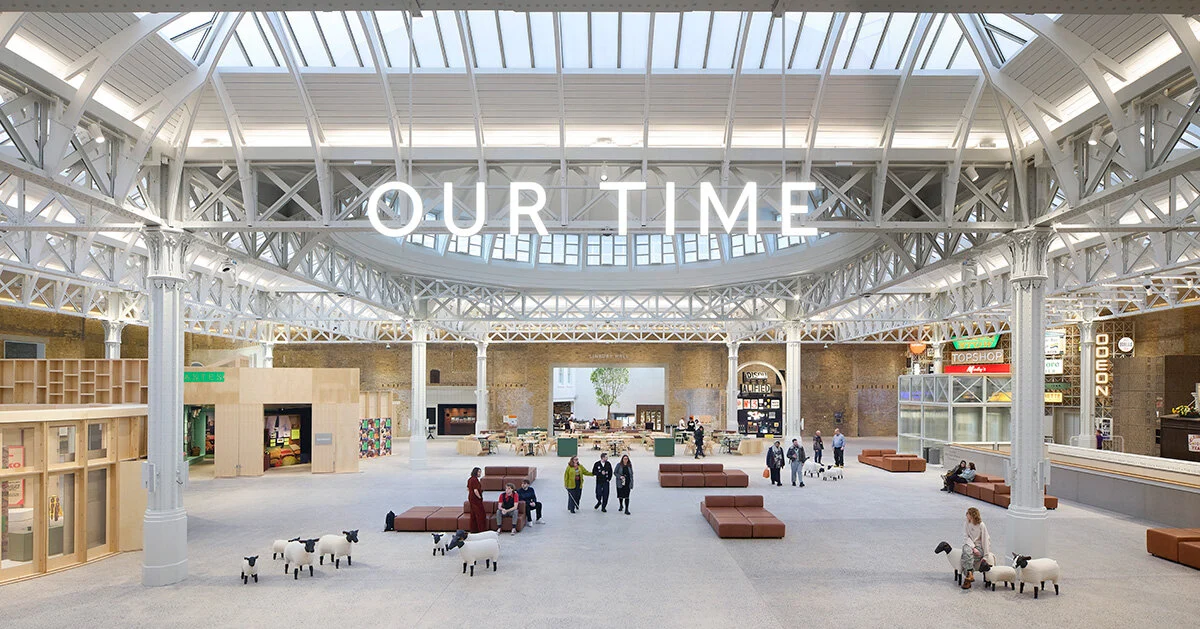
The transformation of Smithfield’s historic General Market into the new home of the London Museum represents a landmark exercise in civic adaptive reuse. Reported to cost £437 million, the collaborative design by Stanton Williams, Asif Khan Studio, and Julian Harrap Architects breathes new life into a vast Victorian trading hub.
Context and Heritage Restoration
Located in the heart of the capital, the Smithfield General Market project required a delicate balancing act between historical preservation and contemporary civic function. Julian Harrap Architects, renowned for their expertise in historic buildings, worked alongside Stanton Williams and Asif Khan Studio to stabilise and restore the fabric of the 19th-century structure. Rather than erasing the layers of industrial history, the design team retained the raw ironwork, weathered brick, and expansive volumes that once served as a bustling centre of meat and poultry trade.
The site’s rich heritage dictated the masterplan. The architects approached the Victorian envelope not as a static monument, but as an adaptable framework capable of housing modern gallery spaces, educational facilities, and public circulation routes without compromising its architectural integrity.
Collaborative Architectural Vision
The division of labour among three distinct practices allowed for a multifaceted design response. Stanton Williams brought its mastery of monumental public spaces and refined material palettes, while Asif Khan Studio introduced innovative spatial interventions that connect the subterranean and ground-level elements of the site. Together, they punctured the heavy Victorian massing with clean, contemporary geometries, creating visual dialogues between past and present.
Materials were chosen for longevity and resonance with the existing industrial context. Portland stone, cast iron, and board-marked concrete sit comfortably alongside original Victorian structural elements. This restrained material palette avoids pastiche, ensuring that new insertions are clearly legible as contemporary additions while respecting the historic weight of the envelope.
Urban Regeneration and Civic Performance
Beyond its cultural remit, the project serves as a catalyst for wider neighbourhood revitalisation in Smithfield. By opening up previously inaccessible courtyards and dead zones of trade infrastructure, the design knits the museum seamlessly into the surrounding urban grain. Porosity is a key performance metric here; multiple entry points invite pedestrians to traverse the site, turning a private nineteenth-century commercial fortress into a public thoroughfare.
For international buyers and urban analysts, the museum’s opening highlights the tangible economic and cultural uplift generated by high-calibre heritage conversions. Civic anchors of this scale invariably alter the surrounding property landscape, shifting the focus from peripheral financial districts to culturally enriched urban cores.
- Adaptive reuse projects succeed by treating historic fabric as an active framework rather than a static museum piece.
- Collaborative architectural consortia can effectively balance heritage conservation with modern spatial demands.
- Restrained material palettes—such as pairing board-marked concrete with original cast iron—create clear distinctions between old and new.
- Urban porosity and public access are essential metrics for successful civic and commercial real estate transformations.
- Cultural anchors significantly drive the long-term desirability and regeneration of surrounding urban districts.
Major cultural infrastructure projects of this magnitude consistently redefine micro-markets, influencing long-term capital appreciation and commercial yields in adjacent districts. The successful conversion of a derelict trading hub into a civic destination signals confidence in heritage-led urban renewal. For investors tracking prime central locations, proximity to world-class cultural anchors underpins asset resilience and enhances the lifestyle proposition for surrounding residential and commercial developments.
Related reads
london museum opens new home in smithfield’s historic general market (Designboom, 24 Nov 2026)
London Museum Opening Kickstarts a Makeover for Smithfield Market (Bloomberg.com, 24 Nov 2026)
Fatbergs, pigeons and Pankhurst: rebranded London Museum opens new £437m home (The Art Newspaper, 24 Nov 2026)
Take me to the fatberg! The £437m new Museum of London is an astonishing sight (The Guardian, 24 Nov 2026)
London Museum Brings Back a Bit of Heritage with Smithfield’s Victorian General Market (freeyork, 25 Nov 2026)
Sources & credits
- Feature: london museum opens new home in smithfield’s historic general market — Designboom Architecture. Linked, not reproduced.
- Main image: Designboom Architecture, from the original feature linked above; all rights remain with the publisher and photographer.
- Headlines via Google News RSS; content belongs to the linked publishers.
Videos are embedded from their original YouTube channels and remain the property of their publishers; ClubProperty hosts no third-party footage or photography. Prices and details are as reported by the sources linked above at the time of writing. Nothing here is financial advice.
関連記事
Snøhetta Completes the Shanghai Grand Opera House
Explore Snøhetta's newly opened Shanghai Grand Opera House, featuring a helical, hand-fan-inspired staircase and…
続きを読むRegulatory Frameworks and Investment Rules at The Ellinikon
An examination of the zoning laws, strategic investment decrees, and residency rules governing major…
続きを読むRestoring Nara Prison: A Meiji-Era Masterclass in Adaptive Reuse
Architect Rie Azuma transforms a 1908 Meiji-era jail into a 48-suite luxury hotel, balancing…
続きを読むTransforming London Railway Arches with Mass Timber
Tigg + Coll Architects convert three Victorian railway arches near Lambeth Palace into functional…
続きを読む