




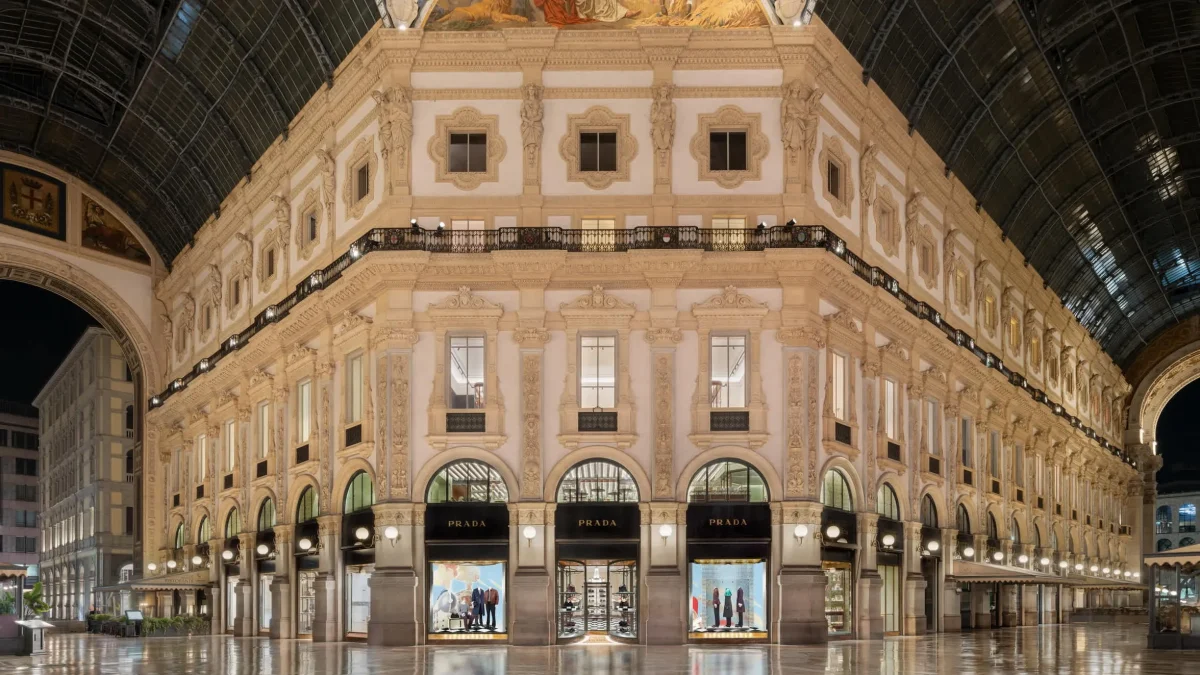
More than a century after establishing its original boutique in the Galleria Vittorio Emanuele II, Prada has unveiled a sweeping new Milanese destination. The hybrid space functions as both a commercial flagship and a curated cultural museum.
A Century of Milanese Retail Evolution
The house of Prada has maintained an unbroken narrative with Milan’s urban fabric since Mario Prada opened the initial shop in 1913 within the glass-roofed arcades of the Galleria Vittorio Emanuele II. That historic location remains a focal point for international luxury retail, anchoring the brand’s heritage in the Lombardy capital. Over the decades, the brand’s physical footprint has evolved from a single leather goods purveyor into a global cultural and architectural force.
This latest real estate milestone builds upon that foundational history by merging commercial enterprise with institutional curation. Rather than relying solely on traditional point-of-sale metrics, the project acknowledges the modern consumer’s demand for experiential spatial design. By integrating exhibition galleries directly into the retail envelope, the house redefines how high-end brands occupy prime urban space.
Architectural Integration Within the Urban Core
Executing a dual-purpose commercial and cultural venue in a historic European city requires precise intervention. Milan’s strict preservation laws governing central districts demand a careful balance between contemporary structural innovation and heritage conservation. The intervention demonstrates how major luxury houses act as private custodians of architectural legacy, funding the meticulous restoration of urban fabric.
Spatial sequencing within the new destination guides visitors deliberately between commercial galleries and exhibition spaces. Materials are selected to reflect both the industrial heritage of the brand and the refined neoclassical language of Milanese architecture. Polished metal finishes, muted stone floor plates, and restrained lighting schemes establish a neutral backdrop for both archival garments and current seasonal collections.
The Shift Toward Experiential Destinations
The intersection of retail and museology represents a broader shift in prime European real estate strategy. Flagship stores are increasingly required to function as cultural anchors rather than mere transaction points. This hybrid model mitigates the volatility of pure retail by driving sustained foot traffic through curated exhibitions and permanent cultural programming.
For international investors observing the Milanese property market, such adaptive reuse projects underscore the resilience of prime high street corridors. High-end retail assets that incorporate cultural dimensions demonstrate superior tenant retention and long-term capital preservation, insulated from shifts in pure e-commerce habits.
- Hybrid real estate models combining retail and cultural spaces drive sustained foot traffic.
- Historic urban cores reward architectural interventions that respect local preservation standards.
- Prime high street assets benefit from institutional-grade cultural anchoring.
- Spatial sequencing can successfully bridge commercial transactions and museum curation.
- Material restraint allows both archival exhibitions and retail displays to coexist harmoniously.
Milan remains one of Europe's most resilient prime retail markets, anchored by historic districts like the Galleria Vittorio Emanuele II and the Quadrilatero della Moda. High-net-worth investors closely monitor how luxury conglomerates acquire and repurpose central real estate assets. Dual-purpose properties that blend commercial storefronts with cultural or museum spaces represent a sophisticated evolution in asset management. By securing marquee locations and investing heavily in architectural adaptation, luxury brands insulate their flagship properties against broader retail market fluctuations. Consequently, prime Milanese commercial real estate continues to command premium capital values and exceptionally low vacancy rates, cementing its status as a defensive asset class for international portfolios.
Related reads
A Prada Paradise Has Opened in Milan, and the New Destination is Both a Shop and a Museum (architecturaldigest.com, 22 Sep 2026)
A Prada Paradise has Opened in Milan, and the New Destination is Both a Shop and a Museum (AD Middle East, 18 Sep 2026)
Sources & credits
- Feature: A Prada Paradise Has Opened in Milan, and the New Destination is Both a Shop and a Museum — Architectural Digest. Linked, not reproduced.
- Main image: Architectural Digest, from the original feature linked above; all rights remain with the publisher and photographer.
- Headlines via Google News RSS; content belongs to the linked publishers.
Videos are embedded from their original YouTube channels and remain the property of their publishers; ClubProperty hosts no third-party footage or photography. Prices and details are as reported by the sources linked above at the time of writing. Nothing here is financial advice.
Related Articles
Kelly Wearstler on the Architecture of Creative Enterprise
AD100 designer Kelly Wearstler shares her operational model for building a global design brand…
Read moreDesigning a Manhattan Duplex Above the High Line
Explore the Manhattan duplex designed by Brian Atwood and Jake Deutsch, featuring bespoke marble…
Read moreLondon’s One Palace Green Debuts With $32 Million Residence
Explore the first completed residence at London's prestigious One Palace Green, styled by Martin…
Read moreModern Miami Beach Mansion Listed at $42 Million
A six‑bedroom, waterfront estate designed by Kobi Karp hits the market for $42 million, underscoring…
Read more