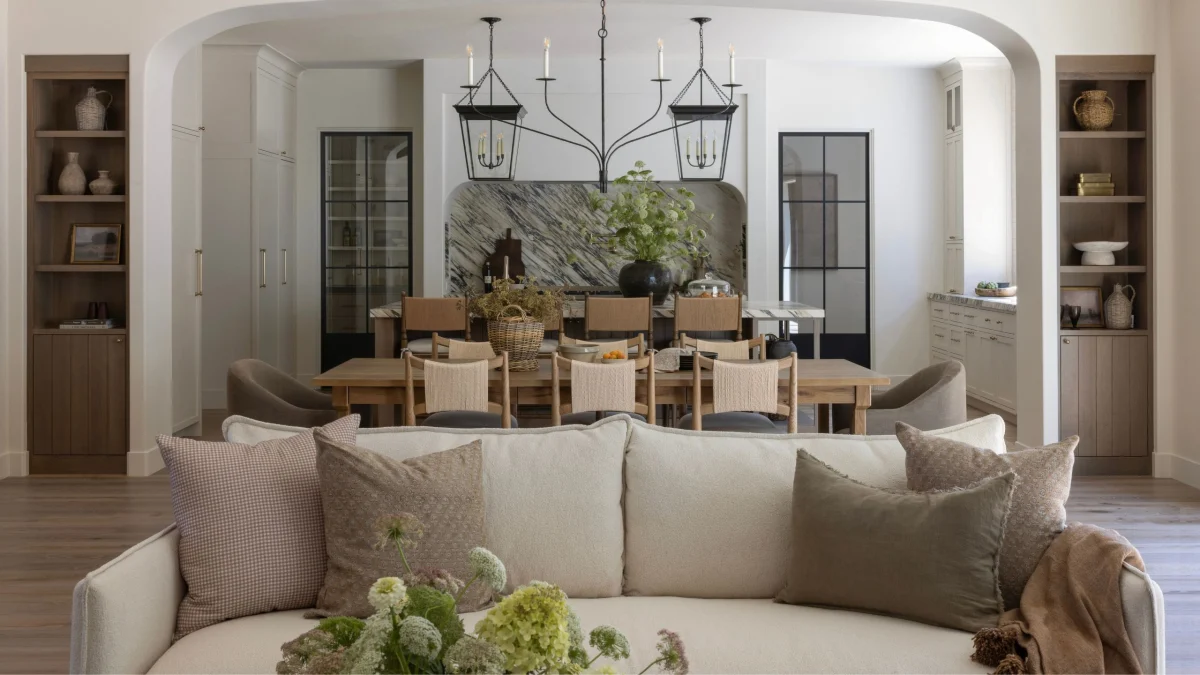
Speculative new-build properties frequently suffer from a sterile uniformity born of caution. By deploying bespoke millwork and layered textures, designer Nicole Salceda demonstrates how to establish authentic character before a buyer even steps through the door.
The Architecture of Detail
When designing without a specific occupant in mind, the primary risk is creating an environment that feels anonymous. To counter this, interior architecture must do the heavy lifting long before furniture enters the rooms. Introducing architectural elements such as customized wall panelling, deep architraves, and tailored ceiling treatments immediately grounds a modern structure in a sense of history and permanence.
In projects overseen by designer Nicole Salceda, reported by Homes and Gardens in October 2026, the emphasis rests squarely on these foundational elements. Rather than relying on bold paint colors that might alienate prospective buyers, the strategy focuses on tactile surfaces. Plaster finishes, subtle lime-wash applications, and solid timber accents create an envelope that feels established rather than freshly minted.
Materiality and Palette for Longevity
A restrained color palette is essential for a speculative asset, but restraint must not tip into monotony. The key lies in tonal layering using natural materials that age gracefully. Unlacquered brass, honed natural stone, and European oak floors develop a patina over time, signaling quality to discerning purchasers who can distinguish between superficial gloss and genuine craftsmanship.
When applied effectively across different price points, these materials anchor the interior. At a higher budget, slab marble and hand-forged ironmongery set a definitive standard. For more modest interventions, tactile ceramic tiles, brushed nickel hardware, and engineered timber capture a similar visual warmth without demanding the same capital outlay.
Layout and Flow in Contemporary Living
Spatial planning in a blank-canvas property must balance open-plan fluidity with moments of domestic retreat. While expansive, interconnected living zones remain a primary demand for premium buyers, undivided vastness can feel cavernous and difficult to furnish. Strategic placement of structural columns, crittall-style internal doors, and low-profile partition joinery helps define distinct zones for dining, relaxation, and cooking.
This zoning approach allows inhabitants to experience intimacy within scale. Furniture placement should reinforce these boundaries rather than float aimlessly in large rooms. Low-slung sofas, anchored by textured wool rugs and complemented by sculptural lighting fixtures, create focal points that draw the eye and establish proportion.
- Prioritise architectural millwork and wall treatments over trendy paint colours to build instant character.
- Select materials like unlacquered brass and honed stone that acquire an attractive patina over time.
- Use internal zoning techniques, such as glass partitions or bespoke joinery, to break up vast open-plan spaces.
- Invest in tactile textiles and layered lighting to soften the inherent sterility of new-build plasterboard.
- Keep fixed architectural elements neutral while introducing personality through easily swappable fixtures and hardware.
For international property investors, the challenge of a speculative new-build lies in achieving broad market appeal without sacrificing distinctiveness. Properties that rely solely on minimalist white boxes often face extended days on market and heavy price resistance from buyers who factor in the immediate cost of adding character. By integrating high-craftsmanship millwork, tactile natural materials, and sophisticated spatial zoning during the initial development phase, a property commands a premium. Buyers recognize the absence of required capital expenditure, positioning the asset strongly for both immediate resale and long-term capital appreciation in competitive global markets.
Related reads
This New-Build Might Have Been Designed Without a Homeowner in Mind – But The Tiny Details Make It Feel So Personal (Homes and Gardens, 8 Oct 2026)
AI Can Design New Proteins. It’s Time to Build Real Biosecurity Guardrails (The Nuclear Threat Initiative, 11 Aug 2026)
New Building Permits Issued For Mission Bay Block 4 East, San Francisco (San Francisco YIMBY, 5 Oct 2026)
EDITORIAL: Thinking About the School Bond Measure, Part Four (Pagosa Daily Post, 8 Sep 2026)
When Authentic Public Engagement, Political Will, and Good Design Come Together (Common Edge, 10 Aug 2026)
Sources & credits
- Feature: This New-Build Might Have Been Designed Without a Homeowner in Mind – But The Tiny Details Make It Feel So Personal — Homes & Gardens. Linked, not reproduced.
- Main image: Homes & Gardens, from the original feature linked above; all rights remain with the publisher and photographer.
- Headlines via Google News RSS; content belongs to the linked publishers.
Videos are embedded from their original YouTube channels and remain the property of their publishers; ClubProperty hosts no third-party footage or photography. Prices and details are as reported by the sources linked above at the time of writing. Nothing here is financial advice.
Σχετικά άρθρα
Timeless Design Choices from Mexico City’s Book‑Lined Bar
How material, light and layout in Em‑Estudio’s basement bar create lasting value and ideas…
Διαβάστε περισσότεραThe Architecture of Color: How to Use Bold Hues with Discipline
Master the application of saturated tones in premium interiors with strategic material pairing, lighting…
Διαβάστε περισσότεραIlluminating the Threshold: Exterior Lighting Design and Value
Explore how intentional exterior lighting design enhances residential appeal, balances atmosphere, and protects long-term…
Διαβάστε περισσότεραThe Architecture of Seasonal Interiors: Beyond the Trend Cycle
Explore how to integrate fleeting festive trends like the popular bow motif without compromising…
Διαβάστε περισσότερα