





Designer Suzanne Tucker has undertaken the sensitive update of a San Francisco residence originally conceived by her late mentor, Michael Taylor. The project bridges decades of West Coast design evolution while preserving the foundational tenets of the celebrated California Look.
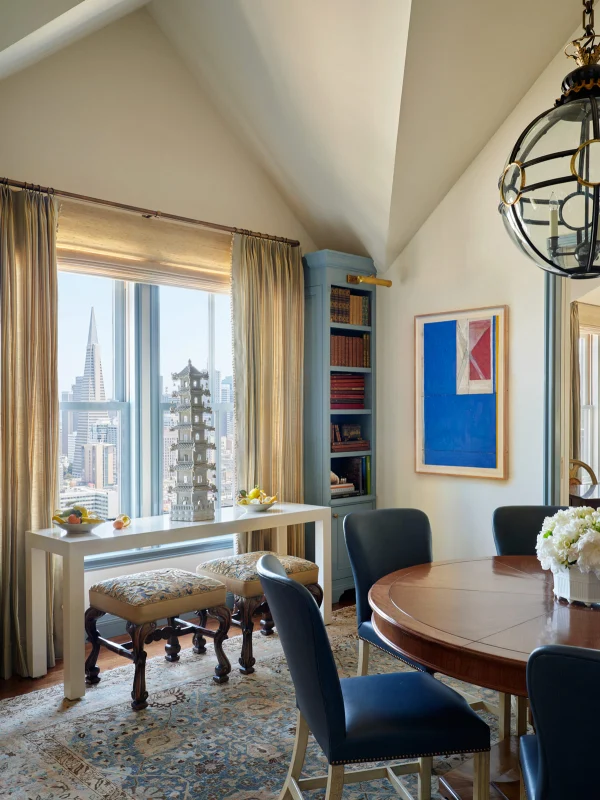
The Evolution of the California Look
Michael Taylor fundamentally reshaped American interior design in the mid-to-late twentieth century by inventing what became known as the California Look. His approach traded formal East Coast traditionalism for expansive scale, uncluttered spaces, unrefined natural materials, and an abundance of natural light. Taylor famously introduced oversized rattan, bleached woods, and massive stone pieces into residential spaces, creating a relaxed yet monumental aesthetic that celebrated indoor-outdoor living.
For designers working in the region today, Taylor’s shadow remains long. His emphasis on architectural volume and tactile surfaces established a baseline for luxury real estate on the West Coast. Revisiting a Taylor-designed interior requires a delicate balance between honouring a significant design pedigree and adapting the spaces for contemporary living patterns, which often demand integrated technology, softer upholstery, and greater functional flexibility.
Tucker & Marks and the Art of the Update
Suzanne Tucker, who leads the venerable San Francisco firm Tucker & Marks alongside her husband Timothy E. Marks, worked directly under Taylor early in her career. That foundational mentorship is evident in her intuitive approach to scale, proportion, and materiality. In updating this San Francisco home, Tucker approached the architecture with a restorative mindset, ensuring that original spatial rhythms remained intact while refreshing the layers that make a house a home.
Rather than erasing the previous interventions, the studio recalibrated the rooms to suit current lifestyle requirements. This involved updating textiles, refining the colour palette to champion quiet earth tones, and sourcing complementary vintage and custom pieces that converse with Taylor’s original vision. The result is a seamless dialogue between two distinct eras of distinguished San Francisco design.
Materiality and Custom Craftsmanship
True to the legacy of both designers, the project relies heavily on bespoke craftsmanship and authentic materials. Custom ironwork, hand-plastered walls, and bespoke millwork were executed by specialist artisans who understand the subtle demands of high-end residential construction. The material palette prioritizes tactile longevity: unlacquered brass, limestone, cerused oak, and heavy natural linens that patina gracefully over time.
This commitment to artisanal detail distinguishes museum-grade residential design from standard luxury property updates. By employing traditional fabrication techniques, the design team ensured that the new elements do not jar against the historical fabric of the house, maintaining a cohesive visual language from room to room.
- Prioritize architectural scale and natural light over decorative clutter to maximize spatial volume.
- Invest in foundational tactile materials like unlacquered metals, stone, and solid wood that improve with age.
- Layer historical design references with contemporary utility to keep heritage properties functional.
- Collaborate with regional artisans for custom plaster, ironwork, and millwork to ensure authentic detailing.
- Recognized designer provenance from firms like Tucker & Marks adds institutional credibility and long-term asset value.
In prime residential markets such as San Francisco, properties carrying the architectural or interior design provenance of established names—particularly figures like Michael Taylor and successors like Suzanne Tucker—command a distinct liquidity advantage. Discerning buyers in top-tier tiers recognize that homes touched by premier designers have undergone rigorous spatial planning and high-specification detailing that generic luxury builds lack. While standard renovations often suffer from shifting aesthetic trends, historical homes updated by respected contemporary practitioners retain their asset value more resiliently. The inclusion of bespoke millwork, custom finishes, and documented design lineage functions as a form of capital preservation, shielding the property against market fluctuations and appealing directly to international collectors of fine real estate.
Sources & credits
- Feature: Suzanne Tucker Updates a San Francisco Home Previously Designed by California Look Creator Michael Taylor — 1stDibs Introspective. Linked, not reproduced.
- Main image: 1stDibs Introspective, from the original feature linked above; all rights remain with the publisher and photographer.
Videos are embedded from their original YouTube channels and remain the property of their publishers; ClubProperty hosts no third-party footage or photography. Prices and details are as reported by the sources linked above at the time of writing. Nothing here is financial advice.
Featured image: Photo: Daniil Vishnevskiy / Pexels
Σχετικά άρθρα
Ken Fulk’s San Francisco Tree House and Designer Equity
Interior designer Ken Fulk's San Francisco Tree House achieves a nearly $10 million sale,…
Διαβάστε περισσότεραTransforming a San Francisco Rental Into an Owned Residence
Discover how a San Francisco rental property was transformed into a permanent home through…
Διαβάστε περισσότεραSan Francisco’s Floating Home Market Swells with a $1.7 Million Listing
A rare Mission Creek houseboat listed at $1.7 million showcases how waterfront living, private berths…
Διαβάστε περισσότεραPresidio Heights Art Dealer Residence Lists for $8.8 Million
The former San Francisco home of late gallerist Rena Bransten lists in Presidio Heights,…
Διαβάστε περισσότερα